

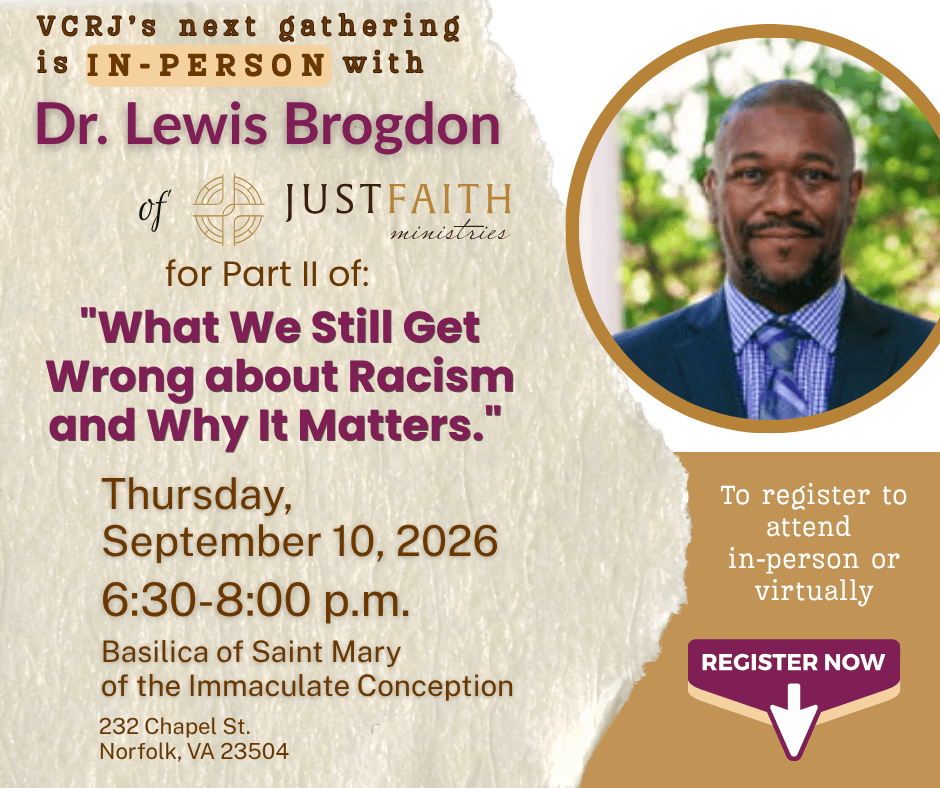
For IN-PERSON attendance, please complete the form below.
For VIRTUAL attendance, please click here to register to receive the Zoom link.
In-Person Registration Form


At our 2026 May gathering, there were several questions in the chat which our guest speaker, Dr. Lewis Brogdon did not have the opportunity to answer. Due to his schedule, he was only able to answer the following questions, but we are happy to announce Dr. Brogdon will be joining us in-person in the fall and hope he can address the remaining questions.
Question: Can you speak to segregation in the church? Are there models that work? What about getting white people to join churches in inner cities or downtown areas instead of remaining in suburban congregations?
Dr. Brogdon:
One of the questions that has haunted me for years comes from Howard Thurman’s classic book, Jesus and the Disinherited. Thurman asked why Christianity has been so ineffective in addressing racial injustice when the faith itself teaches the unity of humanity under God. He noted that Christianity’s inability to overcome racial divisions within its own fellowship raises serious questions about its public witness.
The problem remains with us today. Christian theology affirms that all people are created in the image of God and reconciled in Christ, yet American churches remain among the most segregated institutions in society. Too often race, class, geography, and culture determine where we worship more than the gospel itself.
There have been some encouraging developments. Certain evangelical and neo-charismatic congregations have become more racially diverse than previous generations. Yet many remain predominantly white congregations with minority participation rather than communities characterized by genuine power-sharing, leadership diversity, and cultural integration. Traditional Protestant denominations and many Catholic parishes continue to reflect longstanding patterns of racial and economic separation.
The deeper problem is that Christianity in America often adjusted itself to the racial order of society rather than challenging it. The church frequently mirrored segregation instead of modeling the reconciling vision of the kingdom of God. As a result, race and class continue to predict where we worship and with whom we worship more than our shared identity in Christ.
I believe white Christians have a particularly important role to play in addressing this challenge. Too often the conversation focuses on how people of color can be welcomed into predominantly white churches. We should also ask a different question: Are white Christians willing to enter spaces where they are not the majority? Are they willing to worship under different leadership, learn different traditions, and become part of communities that challenge their assumptions and expand their understanding of the body of Christ?
I have known some who embraced that path by choosing to live in predominantly Black or Brown communities and worship in churches where they were the minority. Many describe the experience as transformative. It broadened their perspectives, deepened their faith, and helped them develop relationships they would not otherwise have formed. The church will not overcome segregation through better hospitality alone. It will require sacrifice, humility, and a willingness to cross social and cultural boundaries in the spirit of Christ. In many ways, that challenge reflects the call of Jesus in Mark 8:34-38. Following Christ often requires us to leave familiar spaces, surrender our comfort, and embrace a larger vision of God’s kingdom.
Question: What is one formation recommendation you would offer to a group like Virginia Catholics for Racial Justice (VCRJ)?
Dr. Brogdon:
One formation practice I would strongly recommend is a deeper engagement with the Lord’s Prayer (Matthew 6:9-13). Christians recite this prayer regularly, but many do not fully grasp its communal and social implications.
The prayer is not about “my” bread, “my” forgiveness, or “my” deliverance. It is about “our” bread, “our” forgiveness, and “our” deliverance. Jesus teaches us to pray not merely as individuals but as members of a human family who are accountable to one another.
American Christianity often reduces spirituality to a private matter. Yet the Lord’s Prayer directs our attention outward toward neighbors, communities, and the common good. It invites us to imagine a world where all people have daily bread, all people experience justice, and all people are delivered from both personal and systemic forms of evil.
Notice how easily we unconsciously individualize the prayer:
| The Text Says | We Often Hear |
| Give us this day our daily bread | Give me this day my daily bread |
| Forgive us our debts | Forgive me my debts |
| Lead us not into temptation | Lead me not into temptation |
| Deliver us from evil | Deliver me from evil |
The New Testament consistently connects prayer and practice. Prayer is meant to shape how we think, how we live, and how we respond to others. The purpose of prayer is not simply to change circumstances but to transform those who pray.
As a spiritual exercise, I sometimes encourage people to mentally expand the words “our” and “us” to include all God’s children. When we pray for daily bread, we are praying not only for ourselves but for those experiencing poverty and hunger. When we pray for deliverance from evil, we are praying not only for personal protection but also for freedom from the systemic evils that harm communities and nations. The Lord’s Prayer reminds us that God’s kingdom is larger than our individual concerns. It calls us to cultivate a spirituality rooted in solidarity, compassion, justice, and the flourishing of all God’s children.
Question: When I talk about racial disparities in the United States, I often hear people say, “But look at all the successful Black people. There are wealthy athletes, celebrities, entertainers, and business leaders.” What is a good response to that argument?
Dr. Brogdon:
One of the most common misunderstandings in discussions about racial inequality is the tendency to point to successful individuals as evidence that systemic barriers no longer exist. The success of a relatively small number of athletes, entertainers, executives, or public figures does not tell us how a population is doing overall.
Journalist Eugene Robinson addresses this issue in his book Disintegration. Robinson argues that African Americans should not be viewed as a single, uniform group. He identifies several distinct segments within the Black community, including a growing middle class, a small but highly visible wealthy elite, recent immigrants, people of mixed-race heritage, and a large segment that continues to struggle with concentrated poverty and limited opportunity. The existence of successful individuals is not evidence that racial inequality has disappeared. The more important question is what the data tell us about the broader population.
Consider wealth, which remains one of the clearest indicators of long-term opportunity and security. White households continue to hold a vastly disproportionate share of wealth in the United States, while Black households possess only a small fraction. The typical white family still has several times the wealth of the typical Black family. These disparities affect housing, education, healthcare access, business ownership, retirement security, and the opportunities that can be passed from one generation to the next.
The same pattern appears in other areas. Significant disparities remain in educational attainment, homeownership, access to capital, neighborhood conditions, health outcomes, incarceration rates, and exposure to concentrated poverty. While important gains have been made since the Civil Rights Movement, progress has often been uneven, fragile, and in some cases reversed.
Pointing to a handful of wealthy celebrities is like looking at a few people standing on mountaintops and concluding that everyone else is living at high altitude. Exceptional cases do not describe the condition of the population as a whole.
Ultimately, the moral question is not whether some African Americans have succeeded. The moral question is whether all people have a fair opportunity to flourish. Justice is measured not by the success of the few but by the well-being of the many. One of the themes I emphasized throughout the webinar is that we must focus on outcomes. The question is not whether progress has occurred. It has. The question is whether the outcomes we see today reflect justice. That is a much harder question, but it is the one that matters most.
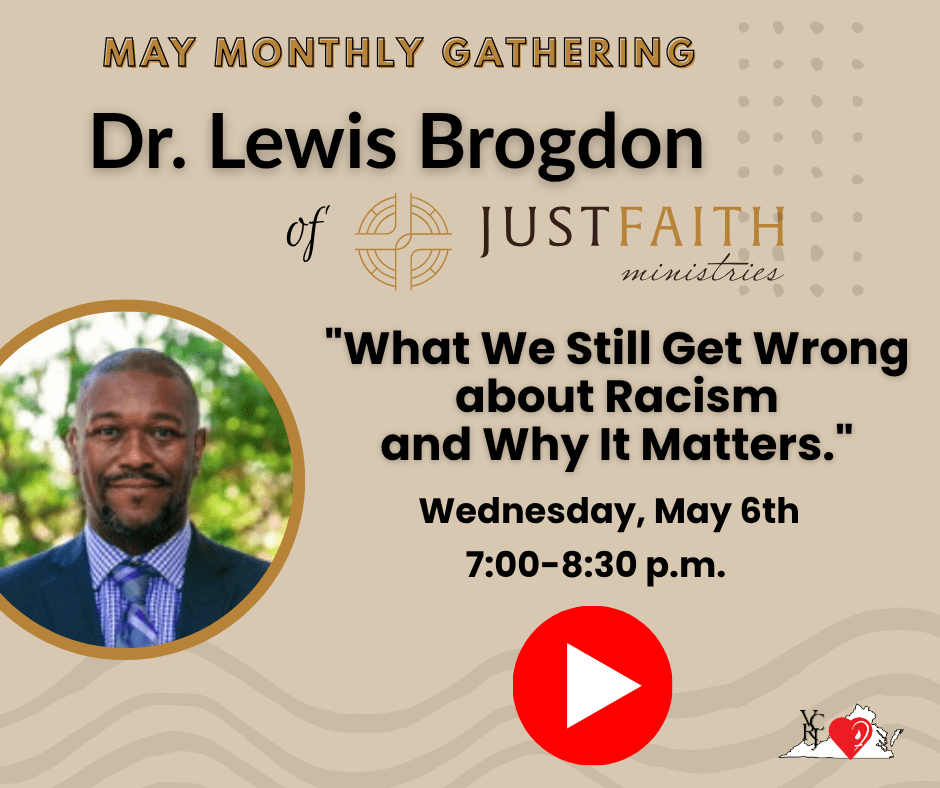
May 2026 Gathering
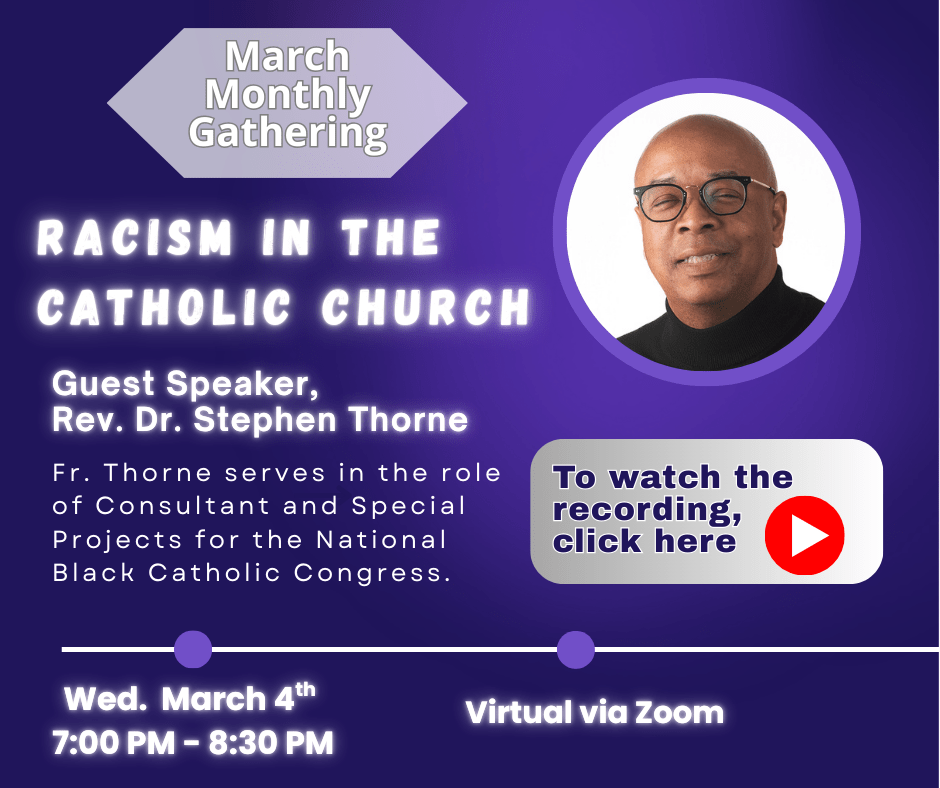
March 2026 Gathering
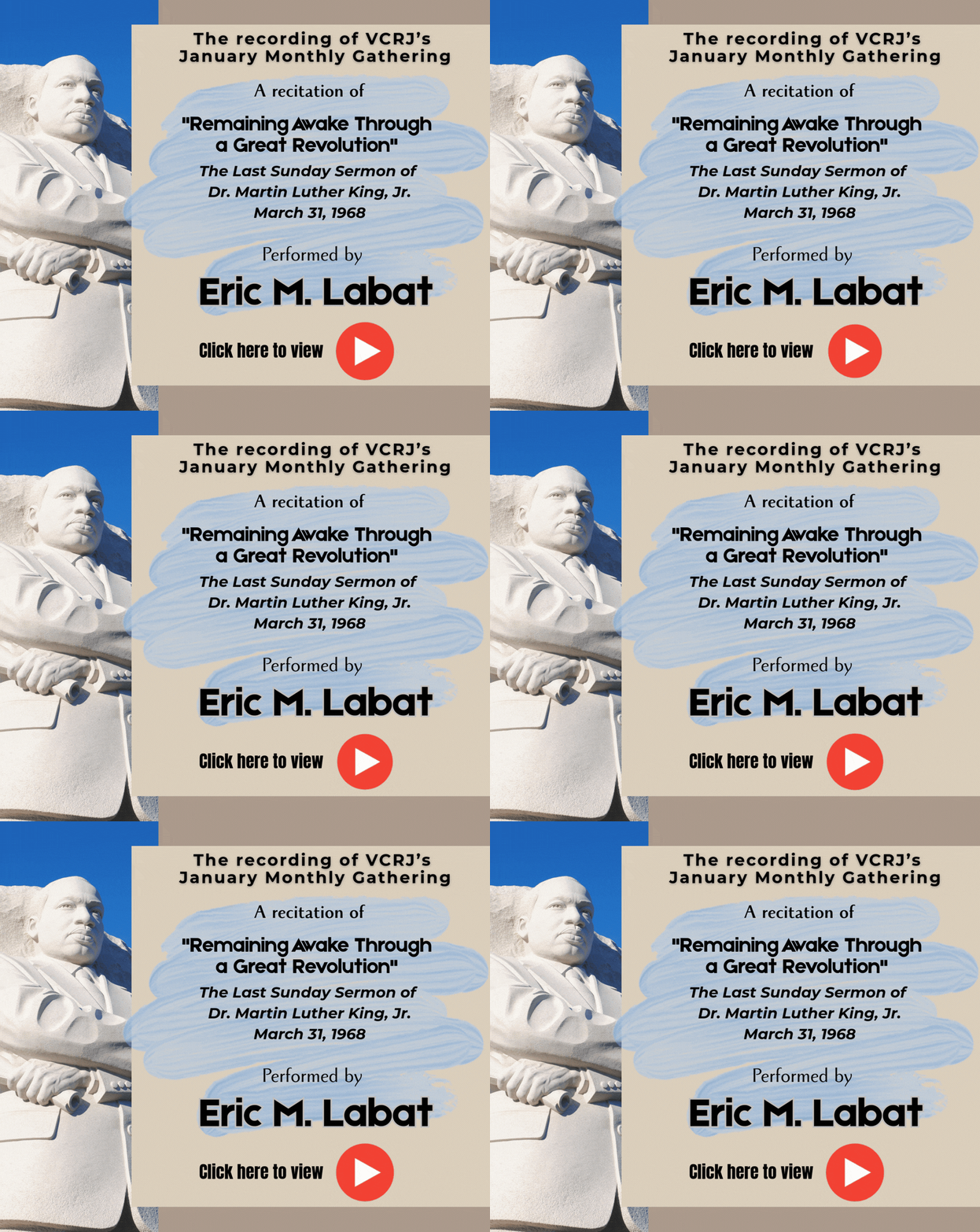
January 2026 Gathering
 Virginia Catholics for Racial Justice